
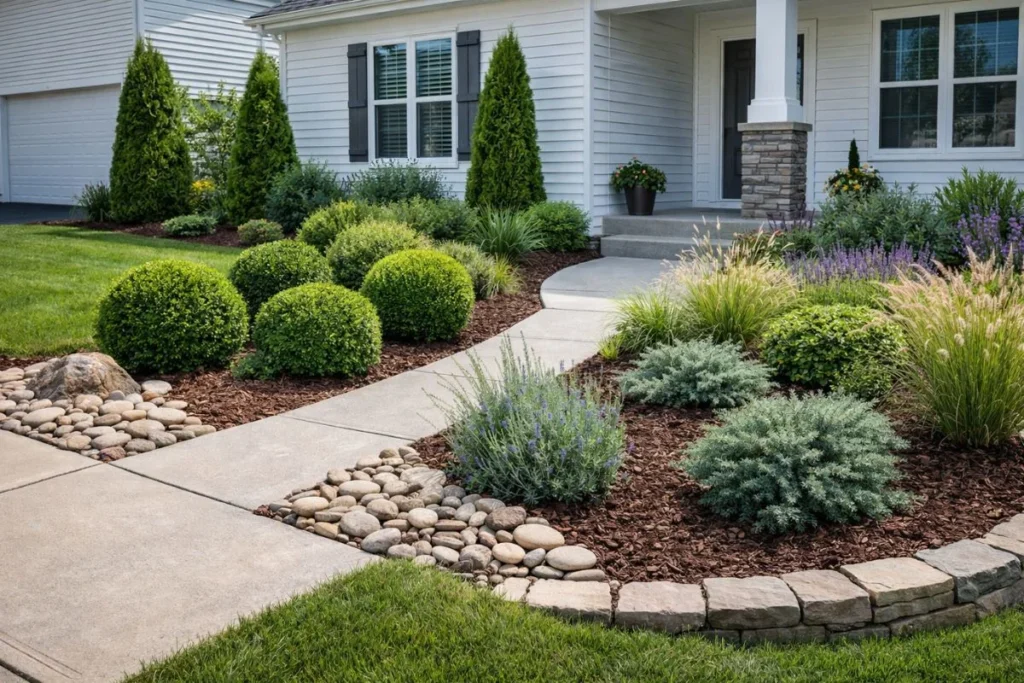
If you're a Dallas–Fort Worth homeowner who loves the idea of a beautiful yard but dreads the reality of maintaining it through brutal Texas summers, relentless drought cycles, and the never-ending demands of grass, weeds, and water bills — you're not alone. Low-maintenance landscaping is one of the fastest-growing priorities among DFW homeowners, and it's driven by something very practical: the North Texas climate makes traditional high-maintenance landscapes genuinely exhausting and expensive to sustain.
The good news is that low-maintenance landscaping in Dallas doesn't mean a bare yard or a field of rocks. Done right, it means a beautifully designed outdoor environment that looks exceptional year-round, requires minimal water and labor to maintain, and works with the natural realities of our climate rather than fighting them at every turn. This guide breaks down the principles, strategies, and specific recommendations that turn a high-maintenance DFW yard into one that practically takes care of itself.
The push toward low-maintenance landscaping in the Dallas–Fort Worth area is more than a lifestyle preference — it's a rational response to several converging realities specific to our climate and region:
DFW summers are brutal and long. North Texas regularly sees temperatures above 100 degrees from June through September, with intense UV exposure that stresses non-adapted plants, accelerates water evaporation, and makes traditional lawn maintenance genuinely unpleasant work. A landscape designed for these conditions practically manages itself. One designed against them requires constant intervention just to stay alive.
Water is increasingly precious. Most DFW municipalities have implemented water restrictions during drought periods, and the long-term outlook for water availability in North Texas makes water-intensive landscaping an increasingly poor investment. Homeowners with efficient, drought-tolerant landscapes simply don't face the same irrigation costs, stress, and compliance concerns as those trying to sustain thirsty traditional lawns.
Clay soil creates ongoing challenges. DFW's expansive clay soil is difficult terrain for many traditional landscape plants. It compacts easily, drains poorly, and swells and shrinks with moisture changes — creating ongoing maintenance challenges for landscapes that weren't designed with these conditions in mind. Low-maintenance landscape design accounts for these soil realities from the beginning.
New Texas legislation supports low-maintenance landscaping. As of September 2025, new Texas legislation restricts HOAs from fining homeowners for drought-stressed lawns during water restrictions and protects the use of drought-resistant landscaping and water-conserving alternatives. DFW homeowners now have more freedom than ever to design practical, climate-appropriate landscapes without HOA pushback.
Busy lifestyles demand it. Most DFW homeowners simply don't have the time to spend their weekends maintaining a demanding landscape. A thoughtfully designed low-maintenance yard returns that time to you — so your outdoor space is something you enjoy, not something that owns you.
Creating a genuinely low-maintenance landscape in the Dallas–Fort Worth area isn't about randomly swapping in some drought-tolerant plants. It requires a thoughtful, systematic design approach built around specific principles that work together. Here's the framework that professional landscape designers use to create truly low-maintenance DFW landscapes:
Traditional turf grass is the single highest-maintenance element in most DFW landscapes. Bermuda grass, St. Augustine, and Zoysia all require regular mowing, fertilization, irrigation, weed control, and aeration to maintain. In a climate as demanding as North Texas, sustaining a large, lush lawn requires substantial ongoing investment of both time and water.
The most effective low-maintenance landscape strategy for DFW homeowners is to reduce lawn area thoughtfully — replacing high-maintenance grass zones with expanded planting beds, paver or stone surfaces, decomposed granite areas, or well-chosen groundcovers that provide greenery without the demands of traditional turf.
This doesn't mean eliminating all lawn. A defined area of quality turf — a front yard panel, a backyard play zone, or a specific functional area — can be maintained efficiently when it's sized appropriately. The goal is eliminating the vast expanses of grass that serve no real purpose except to require maintenance.
Where some lawn is desired, selecting the most drought-tolerant variety for your conditions makes a meaningful difference. Buffalo grass is a native North Texas option that requires minimal mowing and virtually no supplemental watering once established. Zoysia is another relatively low-maintenance warm-season turf that handles DFW's climate better than St. Augustine with less irrigation demand.
This is the most critical decision in any low-maintenance landscape design — and it's where most homeowners who attempt DIY low-maintenance landscapes go wrong. The DFW plant selection trap is choosing plants that look appealing at nurseries or in general gardening content but aren't genuinely adapted to North Texas's specific combination of heat, alkaline clay soil, drought cycles, and occasional hard freeze events.
The solution is to work with a landscape designer who has specific expertise in North Texas horticulture — someone who knows what performs reliably in the DFW area through multiple seasons and years, not just what looks good at the nursery in spring.
Here are the most reliable and beautiful low-maintenance plant choices for Dallas–Fort Worth landscapes:
Texas Sage (Leucophyllum frutescens) — The quintessential low-maintenance DFW shrub. Silvery foliage year-round with stunning purple, pink, or white blooms triggered by humidity changes. Extremely drought tolerant, heat resistant, needs virtually no supplemental watering once established. Actually harmed by overwatering — making it almost too easy to care for in our climate.
Lantana — A Texas-adapted perennial shrub that delivers continuous color from spring through fall on almost no supplemental water once established. Heat-loving, drought tolerant, and almost impossible to kill in a North Texas summer. Available in gold, orange, red, pink, and multicolor varieties.
Dwarf Yaupon Holly (Ilex vomitoria) — A tough, native North Texas evergreen shrub providing dense, compact structure that holds its form with minimal pruning. Virtually no disease or pest issues, highly adaptable to DFW's clay soil, and essentially care-free once established.
Autumn Sage (Salvia greggii) — A native perennial shrub producing continuous blooms in red, pink, coral, and white through the growing season. Heat and drought tolerant, deer resistant, and extraordinarily low maintenance.
Mexican Feather Grass (Nassella tenuissima) — A delicate, airy ornamental grass that moves beautifully in the breeze, requires almost no supplemental water once established, and provides exceptional visual texture alongside more structural shrubs.
Crape Myrtle — The signature DFW ornamental tree. Heat-loving, drought tolerant once established, spectacular summer blooms, beautiful fall color, and interesting winter bark structure. Available in sizes from compact 3-foot dwarf varieties to full-size 25-foot trees — something for every application in a low-maintenance DFW landscape.
Red Yucca (Hesperaloe parviflora) — A striking, grass-like plant native to the Chihuahuan desert that produces tall stems of pink-red blooms throughout the growing season. Virtually zero maintenance, extreme drought tolerance, and excellent deer resistance.
Live Oak and Cedar Elm — For shade tree needs in a low-maintenance DFW landscape, live oak and cedar elm are among the most adaptable, drought-tolerant, and structurally beautiful options available. Both are native or regionally adapted and thrive in North Texas conditions with minimal care once established.
Every square foot of hardscape is a square foot that doesn't need mowing, watering, weeding, or replanting. For DFW homeowners serious about creating a low-maintenance landscape, expanding hardscape coverage is one of the most effective strategies available.
This doesn't mean paving over your entire yard — it means thoughtfully replacing high-maintenance lawn areas with surfaces that add beauty, function, and structure without adding maintenance demands:
Paver patios and courtyards — A well-designed paver patio replaces a section of high-maintenance lawn with a beautiful, functional outdoor living surface that requires only occasional sweeping and periodic joint sand maintenance. The larger your paver patio, the less lawn you have to maintain — and the more functional outdoor living space your property provides.
Stone walkways and pathways — Stone paths connecting key areas of your yard eliminate the worn, muddy bare patches that form under regular foot traffic on lawn areas — while adding visual structure and accessibility throughout the landscape.
Decomposed granite and gravel areas — Decomposed granite is one of the most practical and low-maintenance ground cover options available for DFW landscapes. A well-installed decomposed granite area — with proper base preparation, edging, and stabilizer — provides a clean, naturalistic surface that requires essentially no ongoing maintenance beyond occasional raking and edge maintenance.
Masonry borders and edging — Clean masonry edging between lawn areas and planting beds is one of the least expensive and most impactful low-maintenance improvements available. It eliminates the constant task of manually edging and containing mulch, and creates the kind of clean, defined visual structure that makes a landscape look professionally maintained even with minimal attention.
Decorative rock and boulder features — Strategically placed decorative rock, boulders, and gravel create visual interest while eliminating the grass and weeding demands of the areas they replace. Combined with drought-tolerant plants like yucca, agave, and ornamental grasses, rock features create a distinctly Texas landscape aesthetic that is genuinely beautiful and genuinely low-maintenance.
Mulch is one of the most powerful low-maintenance tools available to DFW homeowners — and it's consistently underused and under-applied. A proper 3-inch layer of quality shredded hardwood mulch in all planting beds simultaneously accomplishes several things that would otherwise require significant ongoing work:
It suppresses weed germination dramatically — reducing weeding time by 50 percent or more in most DFW landscapes. It retains soil moisture during dry periods — reducing irrigation demands and protecting plant roots through North Texas heat spells. It moderates soil temperature — protecting root systems from the extreme temperature swings that DFW clay soil experiences. And it decomposes gradually to enrich soil structure over time — improving drainage and plant health in our notoriously difficult North Texas clay.
Refreshing mulch once per year — typically in fall or spring — is a small investment that pays for itself many times over in reduced weeding, watering, and plant replacement costs throughout the year.
For DFW homeowners who maintain any planting in their landscape, a properly designed and maintained irrigation system is the single most important investment in transitioning from high-maintenance to low-maintenance operation. An efficient drip irrigation or smart sprinkler system delivers water directly to plant root zones — eliminating evaporation loss, reducing water bills, and preventing the overwatering that kills more North Texas plants than drought does.
Modern smart irrigation controllers use weather data and soil moisture sensors to automatically adjust watering schedules based on actual conditions — turning the system off during and after rain events, reducing output during cooler periods, and scaling up during the hottest stretches of DFW summer. A properly programmed smart irrigation system essentially manages your landscape's water needs for you, without requiring daily attention or intervention.
Drip irrigation is particularly valuable for planting beds with drought-tolerant species — it delivers precisely the modest amount of water these plants need directly to the root zone, preventing the soggy conditions that damage many drought-tolerant plants when standard spray heads are used.
One of the most common mistakes DFW homeowners make when transitioning to a low-maintenance landscape is expecting zero maintenance from day one. Even the most drought-tolerant, low-maintenance plants in North Texas require consistent irrigation during their establishment period — typically the first one to two growing seasons after planting. This is when root systems are developing and the plant hasn't yet accessed the deep soil moisture reserves that allow it to thrive independently.
A professional landscape designer will plan an appropriate establishment irrigation schedule, advise on mulching depth and timing, and help you understand when each plant species has established well enough to transition to minimal supplemental watering. Skipping the establishment period to save water upfront is the primary reason low-maintenance plant selections fail in DFW landscapes — and it's completely avoidable with the right guidance.
North Texas clay soil drainage problems are the hidden enemy of many DFW landscaping investments — including low-maintenance ones. When water pools in planting beds, it creates anaerobic soil conditions that kill even drought-tolerant plants. When water collects against the home's foundation, it creates expansion pressure that damages the structure. And when improperly graded surfaces channel runoff across lawn or planting areas, it creates erosion that undermines the landscape design.
Every low-maintenance landscape design for the DFW area should address drainage as a foundational element — ensuring all planting beds, lawn areas, and hardscape surfaces are graded to direct water away from structures and toward appropriate drainage outlets. A landscape that drains properly requires dramatically less intervention than one where water management is an ongoing challenge.
Here are specific design approaches that work particularly well for creating low-maintenance landscapes throughout the Dallas–Fort Worth area:
The expanded bed approach — Replace the narrow builder-installed planting strips around your home's foundation with properly sized, deep planting beds (minimum 4 to 5 feet deep) planted with layered drought-tolerant shrubs and groundcovers. Wider beds require no more maintenance than narrow ones, accommodate proper plant sizing, and dramatically reduce the ratio of high-maintenance lawn to low-maintenance planting.
The paver and planting combination — Replace a significant portion of backyard lawn with an expanded paver patio combined with defined planting beds along the perimeter. The patio eliminates lawn maintenance from that zone entirely, and the perimeter beds framed with masonry edging stay neat and tidy with minimal intervention.
The decomposed granite courtyard — In areas where lawn struggles due to shade, tree root competition, or high foot traffic, replace the struggling grass with a decomposed granite courtyard bordered by drought-tolerant plantings. Decomposed granite is stable, clean, and requires virtually no maintenance beyond annual raking.
The layered shrub border — Rather than isolated specimen plants in the landscape, create continuous layered shrub borders along fence lines, property boundaries, and foundation zones. Layered shrub borders suppress weeds through plant coverage, require pruning only once or twice per year, and provide consistent seasonal interest through bloom color, texture, and structure.
Strategic shade tree placement — Mature shade trees over patio areas, walkways, and south or west-facing lawn zones dramatically reduce water demands, lower surface temperatures, and create microclimates where lower-maintenance plants can thrive. Planning for shade trees from the beginning of a landscape design project — even when they're small — pays enormous dividends in maintenance reduction as they mature.
Low-maintenance landscaping in the DFW area does not mean zero maintenance. Even the most efficiently designed, properly planted, and well-irrigated landscape requires periodic attention — seasonal pruning of certain plants, annual mulch refreshment, irrigation system checks, and occasional spot weeding. What low-maintenance landscaping delivers is a dramatic reduction in ongoing labor and cost compared to a traditional high-maintenance landscape — not complete elimination of all yard work.
The honest expectation for a professionally designed low-maintenance DFW landscape is approximately 80 percent less time and water than a traditional turf-heavy, mixed planting landscape — while maintaining or improving visual quality. That's the meaningful, achievable outcome that makes low-maintenance landscape design one of the most requested services from Dallas–Fort Worth homeowners today.
At Salas Outdoors, low-maintenance landscape design is one of our most requested services for Dallas–Fort Worth homeowners. Our team of ISA-certified arborists and experienced landscape designers brings specific expertise in North Texas horticulture — knowing which plants genuinely perform in our climate, which hardscape solutions eliminate maintenance demands most effectively, and how to integrate drainage, irrigation, and planting design into a cohesive system that works beautifully year after year with minimal homeowner intervention.
We design every low-maintenance landscape as a complete system — addressing drainage, soil conditions, irrigation infrastructure, plant selection, hardscape integration, and mulching strategy together rather than in isolation. The result is a DFW yard that looks exceptional through every season and takes care of itself the way a well-designed landscape always should.

Ready to stop fighting your yard and start enjoying it? Request your free landscape design estimate from Salas Outdoors today and let's create a Dallas–Fort Worth landscape that looks beautiful year-round — without demanding your weekends.


