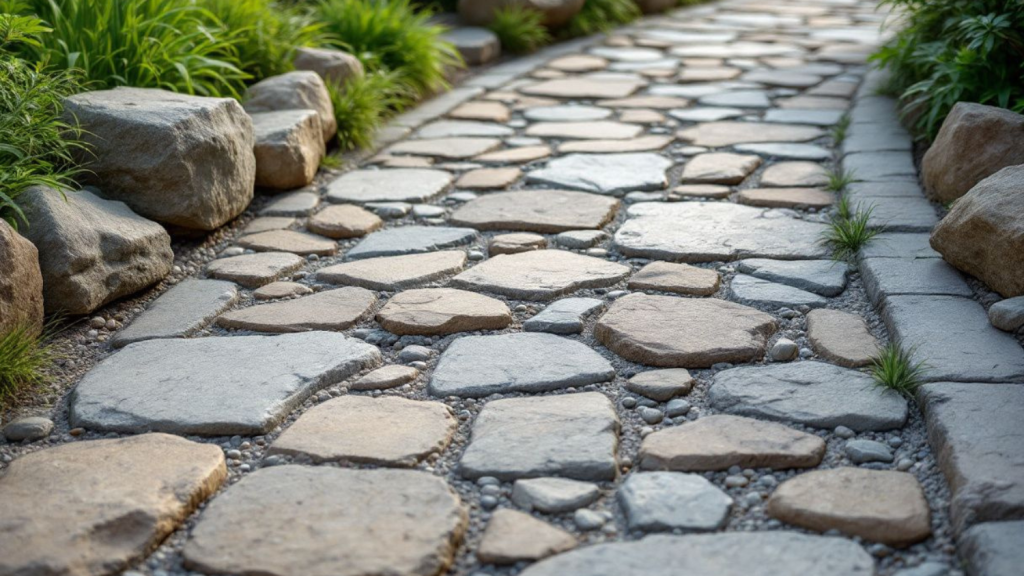
A stone walkway is one of the most underestimated improvements a Dallas–Fort Worth homeowner can make to their property. It seems like a simple addition — a path from here to there — but a professionally designed and installed stone walkway does far more than guide foot traffic. It defines the structure of your landscape, creates a welcoming sense of arrival at your front door, connects outdoor living areas in a cohesive and elegant way, and adds a level of craftsmanship and visual quality that elevates the entire appearance of your home from the street.
For DFW homeowners, stone walkways and pathways also solve a very practical problem that many North Texas yards share: muddy, eroded, or simply undefined paths between the driveway, front entry, backyard, and outdoor living areas. When grass wears away under regular foot traffic and clay soil becomes a muddy mess after rain, a stone pathway is the permanent, beautiful solution.
This guide covers everything Dallas–Fort Worth homeowners need to know about stone walkways — the best materials for the North Texas climate, design styles, installation considerations, costs, and how to get the most out of this highly impactful outdoor upgrade.
Before diving into materials and design, it's worth understanding just how much impact a well-designed stone walkway has on your property — both in terms of daily enjoyment and long-term value.
First Impressions — Your front walkway is the literal path that guides every visitor from the street to your front door. A beautiful stone walkway creates a sense of arrival and quality that sets the tone for your entire home before anyone steps inside. Real estate professionals throughout the DFW market consistently note that a quality stone front walkway is one of the most visible and impactful curb appeal improvements available — and buyers notice the difference immediately during home tours.
Functional Problem-Solving — In Dallas–Fort Worth's clay-heavy soil, grass along heavily trafficked paths wears away quickly, leaving muddy bare ground that erodes, tracks into the house, and looks uninviting. A stone walkway solves this permanently — providing a durable, stable, all-weather surface that stays clean, safe, and beautiful regardless of rain or drought conditions.
Landscape Definition — One of the hallmarks of a professionally designed landscape in the DFW area is clear structure — defined edges, clear pathways, and purposeful connections between different areas of the yard. Stone walkways and pathways create this structure, guiding the eye through the landscape, separating zones, and giving the entire yard an intentional, designed quality.
Connection Between Outdoor Living Areas — In backyards throughout Frisco, Plano, McKinney, and Dallas, stone pathways connect the patio, the outdoor kitchen, the fire pit area, the pool deck, and the garden in a unified, cohesive way that makes the entire outdoor living space feel planned and purposeful rather than randomly assembled.
Year-Round Safety — Stone walkways with appropriate texture provide reliable footing in wet conditions — a practical safety benefit for families with children, elderly family members, or anyone navigating the property after North Texas rain events that can leave surfaces slippery.
Material selection is where stone walkways succeed or fail in the North Texas environment. DFW's expansive clay soil, extreme summer heat, UV exposure, and occasional hard freeze events all affect how different materials perform over time. Here's what Dallas–Fort Worth homeowners need to know about each option:
Limestone is the quintessential stone walkway material for North Texas — and for very good reasons that go beyond aesthetics. Austin limestone and Lueders limestone are both locally sourced or regionally available, which means they're specifically adapted to the Texas climate and deliver exceptional long-term performance in the DFW outdoor environment.
Austin Limestone features warm honey and cream tones with natural texture variation that gives it an organic, timeless character. It complements virtually every architectural style common throughout the DFW metroplex — from traditional brick homes in established neighborhoods to modern contemporaries in newer communities. Its natural texture provides excellent traction underfoot, even when wet, and its warm coloration stays relatively cool underfoot in summer sun compared to darker stone options. Austin limestone is widely considered the most versatile and widely applicable stone walkway material in the Dallas area.
Lueders Limestone is a denser, more refined option with uniform gray tones and precise edges that create a more contemporary, sophisticated aesthetic. It's the preferred choice for modern home styles throughout the DFW area — particularly in newer communities where clean lines and contemporary design language are the standard. Lueders limestone's density means it handles heavy foot traffic and extreme weather without chipping or staining, making it a particularly durable long-term investment.
Both limestone varieties perform beautifully in DFW's climate — heat resistant, durable through freeze-thaw cycles, and naturally non-slip when finished with an appropriate surface texture.
Flagstone encompasses a variety of flat natural stone materials — sandstone, slate, and other regional varieties — cut or broken into irregular shapes that create organic, flowing walkways with a relaxed, naturalistic character. Flagstone walkways are particularly popular for garden paths, side yard connections, and secondary pathways where a less formal aesthetic is desired.
The defining visual characteristic of a flagstone walkway is its irregularity — no two pieces are identical, and the mosaic-like arrangement of shapes creates a surface that feels like it grew out of the landscape rather than being installed on top of it. Combined with low-growing groundcover plants like creeping thyme or moss filling the joints, a flagstone garden path becomes one of the most visually captivating features in a DFW residential landscape.
In the Dallas area, sandstone flagstone is popular for its range of earth tones — from warm tans and rusts to cooler grays and blues — that complement the warm, earthy palette of North Texas landscapes. Sandstone handles DFW's climate well and provides good natural traction.
The primary installation consideration with flagstone in the DFW market is joint treatment. For informal garden paths, dry-set flagstone with planted joints or loose gravel fill is the most popular and practical approach — it allows individual stones to flex independently with DFW's clay soil movement without creating cracking issues. For formal front entry walkways, mortared flagstone creates a more refined, finished appearance but requires an experienced installer who understands how to accommodate North Texas soil movement in the mortar joint specifications.
Concrete pavers are the most versatile and widely used material for formal walkways in the DFW area — and modern concrete paver products have evolved far beyond the basic utilitarian options of the past. Today's premium concrete pavers are available in large-format slabs, natural stone textures, warm travertine-like finishes, and classic brick profiles — giving DFW homeowners enormous design flexibility at a price point that is significantly more accessible than natural stone.
For front yard walkways in particular, concrete pavers deliver several important advantages. They're manufactured to precise dimensions, which makes clean geometric layouts and consistent joint spacing straightforward to achieve. They're available in lighter colors that stay cooler underfoot in DFW summers. And they're installed in an interlocking system that flexes with North Texas clay soil movement — eliminating the cracking and settling that plague poured concrete walkways over time.
Concrete paver walkways can be designed to closely coordinate with or match an existing or planned paver patio, driveway, or pool deck — creating a unified hardscape design across multiple outdoor surfaces that is the hallmark of professionally designed DFW outdoor environments.
Brick is one of the most beloved walkway materials in established DFW neighborhoods — and with good reason. The warm, rich tones of brick complement the traditional and transitional architectural styles that dominate residential areas throughout Dallas, Plano, Richardson, and other established communities in the metroplex. A brick front walkway on a traditionally styled home creates a visual harmony between the home's exterior and the landscape that feels both welcoming and permanent.
Clay brick pavers are extremely durable in the DFW outdoor environment — resistant to UV fading, able to withstand the temperature extremes of North Texas winters and summers, and naturally slip-resistant when finished with a wire-cut or tumbled surface texture. A professionally installed brick walkway looks exceptional on day one and develops a richer, more beautiful character over time — aging gracefully in a way that few manufactured materials can replicate.
For garden paths, side yard connections, and informal backyard pathways where a relaxed, naturalistic aesthetic is desired over a formal hardscape look, decomposed granite and crushed gravel offer an appealing and practical option. A well-installed decomposed granite pathway — with proper base preparation, edging, and stabilizer to prevent surface erosion — is durable, easy to maintain, provides good drainage, and creates the kind of casual, organic path feel that complements cottage-style gardens and naturalistic landscape designs.
In DFW, decomposed granite pathways are most commonly used as secondary garden paths and connections between primary stone or paver surfaces — rather than as the primary front yard walkway where a more finished appearance is typically expected.
Stepping stone pathways — individual large-format stones spaced to match a natural walking stride, set into lawn areas or groundcover — create a casual, welcoming path feel that works beautifully for low-traffic connections across grassy areas, from the patio to the garden, or through planting beds where a full continuous walkway isn't needed.
In DFW, large-format limestone slabs, concrete pavers, and natural stone pieces are all commonly used as stepping stones. The key to a beautiful and functional stepping stone pathway is appropriate spacing (approximately 24 to 26 inches on center for a comfortable natural stride), proper setting depth so the stones are flush with or slightly above the surrounding surface, and a stable base that prevents rocking underfoot.
Beyond material selection, these design decisions have the biggest impact on how your stone walkway looks and functions in the DFW landscape:
Width matters enormously. The most common mistake in residential walkway design is building too narrow. A front walkway should be a minimum of 4 feet wide — ideally 5 to 6 feet — to allow two people to walk comfortably side by side. A pathway that feels cramped discourages use and undermines the welcoming feeling a front walkway is meant to create. Backyard pathways connecting major areas should be a minimum of 3 to 4 feet wide.
Curves vs. straight lines — Straight walkways create a formal, direct approach and work well with traditional and contemporary home styles. Gently curved walkways create a more relaxed, organic feel and can make a front yard feel more expansive by guiding the eye through the landscape rather than directly to the door. The choice should be driven by your home's architectural style and the character you want your landscape to convey.
Border and edge treatment — A contrasting border material — a row of brick set alongside a limestone path, or a different-colored paver framing a concrete paver walkway — creates visual definition and a polished, finished appearance. Border edging also serves a structural purpose, containing the field material and preventing edge migration over time.
Planting integration — Stone walkways framed by well-designed planting beds on both sides create the most visually compelling approach to any home. Low-growing, drought-tolerant plants like dwarf yaupon holly, ornamental grasses, lantana, and autumn sage are particularly effective alongside North Texas walkways — they frame the path without overgrowing it and perform beautifully in our climate with minimal maintenance.
Lighting integration — Path lighting installed alongside a stone walkway is one of the most impactful and cost-effective upgrades available. Low-voltage LED path lights on both sides of the walkway create a welcoming, beautifully lit approach after dark and extend the visual impact of your front walkway investment into the evening hours — which represents a significant portion of total visibility in a residential neighborhood.
Steps and grade transitions — Any elevation change along a walkway route is a design opportunity. Stone or brick steps that match or complement the walkway material create a cohesive, integrated design. In DFW backyards where retaining walls and grade changes are common, integrating stone steps into the walkway design creates a unified hardscape vocabulary across the entire outdoor environment.
Stone walkway costs in the Dallas–Fort Worth area vary based on material, width, length, design complexity, and site conditions. Here's a practical cost framework for DFW homeowners:
Basic concrete paver walkways — a standard front walkway using quality concrete pavers — typically run $15 to $25 per square foot installed in the DFW area.
Natural limestone walkways (Austin limestone or Lueders) — typically run $20 to $35 per square foot installed depending on stone selection, cut precision, and joint treatment.
Flagstone walkways — typically run $18 to $35 per square foot installed, with variation based on stone type, jointing method, and path configuration.
Brick paver walkways — typically run $20 to $30 per square foot installed in the DFW area.
Decomposed granite or gravel paths — typically run $5 to $12 per square foot installed including proper base, edging, and stabilizer.
For a typical front walkway of 50 to 80 square feet in the Dallas area, homeowners can expect a total investment of $1,000 to $2,800 for simpler materials up to $3,000 to $6,000 or more for premium natural stone with lighting and border details. More extensive pathway systems connecting multiple areas of a backyard naturally run higher based on total square footage.
The single most important investment in any stone walkway project is proper base preparation — specifically, adequate depth of compacted aggregate base to accommodate DFW's clay soil movement. This is not visible in the finished product but is the primary factor determining whether your walkway performs beautifully for decades or begins shifting and settling within a few seasons.
The most visually cohesive and highest-value outdoor environments in the DFW area use consistent or complementary hardscape materials across multiple surfaces — walkways, patio, pool deck, driveway borders, and retaining wall caps all speaking the same material language. When your front walkway coordinates with your driveway pavers, and your backyard stone pathway connects naturally to your patio surface, the entire outdoor environment feels unified and professionally designed rather than assembled piecemeal.
At Salas Outdoors, we design walkways as part of the integrated hardscape and landscape design for the entire property — ensuring that every stone pathway we install works as a purposeful element of the complete outdoor environment rather than an isolated addition.
At Salas Outdoors, we've been designing and installing stone walkways and pathways for Dallas–Fort Worth homeowners since 2010. From natural limestone front entry walkways to flagstone garden paths, brick connections, and complete backyard pathway systems, our certified masons bring the expertise, craftsmanship, and DFW-specific knowledge that every stone walkway project deserves.
We use premium locally appropriate stone and paver materials, build on properly compacted bases engineered for North Texas clay soil conditions, integrate proper drainage in every installation, and design every walkway as part of the complete landscape — ensuring it looks intentional, functions beautifully, and adds lasting value to your property.

Ready to add a stone walkway that transforms the appearance, functionality, and value of your Dallas–Fort Worth property? Request your free estimate from Salas Outdoors today and let's design a pathway that makes your home look exceptional from every approach.


